Uniting the Right. Not the Way Most People Mean It

From a Restore Britain activist A Boon
This is a guest article by A Boon (@BoonARTno10). The views expressed are the author's own.
People hear “unite the right” and think another deal with Reform or what’s left of the hard-line Tories. That’s not it. Reform’s already drifted. The remaining hard Tories don’t have the numbers or the consistency to do the job. What’s needed is something more practical: mergers where they make sense, associations and wings where they don’t, and local outfits that keep their own identity but sit under one national banner at election time.
Restore’s already shown how this works with Great Yarmouth First. Local people organised around their own place, with a clear link to the national party. Same idea can be used across Britain and in Northern Ireland. Every vote split between parties that basically agree on borders, sovereignty, and putting the native people of these islands first is a vote handed to everyone else. Smaller parties and local groups already have the people on the ground, the councillors, and the trust. Linking them properly stops the waste.
Britain isn’t an abstract idea. It’s a particular set of peoples with their own history and ways of doing things. Anyone serious about defending that has a reason to work together. Local control isn’t the opposite of looking after the nation. It’s how you actually do it. Power closer to the people who live somewhere, without the current devolved parliaments that mostly push separation or metropolitan priorities.
Who fits where
British Democrats, UKIP, Heritage, and Reclaim are close enough on immigration, identity, and free speech that merger or tight integration makes sense for most of them. A lot of their people have already written Reform off. SDP comes in too. Enough shared ground on stopping mass immigration and cultural sovereignty that the economic differences can be worked through under Restore’s lead rather than treated as a deal-breaker.
On the Celtic side, British Unionist Party merges but keeps its branding. Same for Sons of Cornwall. Both have real local recognition. The point is stronger local government and the native people of those places coming first in their own areas, inside a restored Britain, not new national parliaments. Gwlad stays as a limited association for the same reason: useful on local priorities, not on independence.
In Northern Ireland it’s an association. TUV is the natural anchor because it’s already harder on the Union and the current arrangements. DUP and UUP bring the organisation and local networks. Coordinate at Westminster elections, keep local tactics with them. Later on there might be room to talk to parties in the Republic that care about sovereignty and migration, but that’s not the first step.
The hyper-local parties (Residents for Uttlesford, Broxtowe Alliance, People’s Independent Party, Our West Lancashire, Canvey Island Independent Party) follow the Great Yarmouth First model. They keep their names and their councillors. They focus on planning, services, and stopping remote decisions wrecking their areas. At national elections they sit with Restore. They don’t have to swallow every national policy. They get the bits that matter to them: borders sorted, local control protected, British workers first.
Policy overlaps and the tent
Most of these parties already agree on the big things. Sovereignty isn’t optional. Mass immigration has to be reversed, not managed. British citizens come first for housing, benefits, and jobs. Demographic change without consent is a problem. Free speech matters. Native cultures aren’t just one option among many.
Differences are real. Restore is the hardest on immigration: net negative, removals for people who don’t meet basic tests, asylum system gone, citizenship slow and rare. Heritage and UKIP have useful detail on how you actually do the removals and the visa caps. SDP is more assimilationist and wants more state involvement in industry and housing. Reclaim is stronger on the free-speech side than on the full demographic picture. Localist groups mostly don’t have national ideologies at all.
That’s fine. Restore is the national vehicle. Candidates stand on the core: native peoples recognised, immigration reversed, one legal system, Union kept, free speech defended. Local wings and affiliates keep their branding and their day-to-day priorities. If being inside gets a group most of what it wants (controlled borders, local planning protected, their own people first in their own area) then staying outside and winning nothing is the worse option.
Home for nationalism
Restore is where nationalism, nativism, and localism actually get organised. Not a purity test that drives everyone into microparties, and not a civic shell where anyone becomes British after a few years of paperwork. Native peoples of these islands (English, Scottish, Welsh, Irish, Cornish, Manx, Channel Islanders, Orcadians, Shetlanders and the rest) are recognised as such. Their cultures come first in domestic affairs. In each place the historic people of that place are first among equals. Economy works for people born here. High-trust society, law and order, common sense.
Being British isn’t a short admin process. It’s for people born here to British parents, or for those who put in decades of actual commitment. The liberal “Yookay” version gets dropped. Past failures get acknowledged: lockdowns that cost a generation, cover-ups of imported crime for the sake of cohesion.
Local groups that disagree on tax rates or the exact speed of net-zero reversal can still be in the tent. They deliver the shared core and keep their local focus. That’s how you stop splitting the vote among people who already know Reform isn’t going to do it.
Red lines
Any merger, wing, or association has to accept these. Everything else can be talked about.
1. Native peoples first. Native peoples of these islands come first, including the broader groups (Cornish, Manx, Channel Islanders, northern islanders and so on). Their continuity is a policy goal, not an accident.
2. Immigration reversed. Net negative, illegals out, people who fail basic tests out, asylum system ended, citizenship rare and slow.
3. Sovereignty. One legal system. Union maintained. Devolved parliaments that act as a path to separation get reformed or scrapped.
4. Native cultures first. Native cultures first in domestic affairs, and in each region the historic people of that region are first among equals.
5. Local people for local positions. Local people stand for local positions, but they don’t campaign against the national core at general elections.
Economics, exact tax levels, secondary social questions, and Northern Ireland tactics stay flexible. If a partner gets borders controlled, native peoples recognised, and local planning protected, they’ve already got most of what they came for.
Policy Comparison
Key positions for the main non-hyper-local parties. Hyper-local groups are left out because they focus on place-specific issues rather than national programmes.
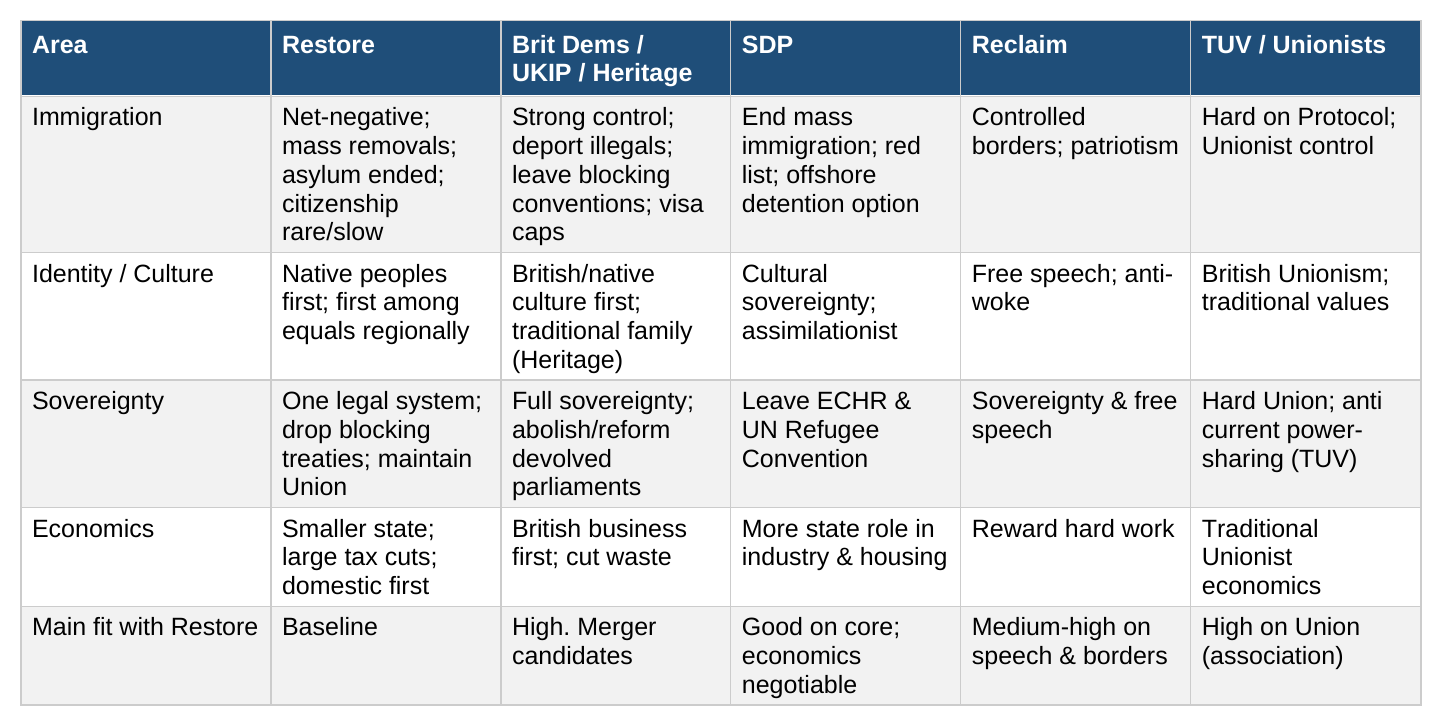
Notes: Positions drawn from published platforms and recent statements. Localist parties fit the affiliate model instead of this table.
Specific policy areas
Immigration and borders. Restore sets the floor: net-negative, mass removal of illegals and those who fail basic tests on language, work, non-dependence and cultural fit, asylum system ended, citizenship rare and slow. UKIP and Heritage supply the practical tools (Channel presence, visa caps, leaving the blocking conventions). SDP’s red-list and offshore detention ideas can be used as operational options. The merged line is Restore’s reversal programme with the others’ implementation detail bolted on.
Identity and culture. Native peoples of the islands recognised, and in each region they stand as first among equals. Heritage’s traditional family and Christian principles language, plus Reclaim and Heritage free-speech protections, give the positive content. The empty civic “Yookay” version is dropped across the board.
Law, order and free speech. Death penalty referendum for the worst crimes, ban on burqa/niqab, expanded self-defence rights in the home, and a Freedom Act style repeal of hate-speech provisions. These sit comfortably with Heritage and UKIP positions and reinforce the high-trust society goal.
Sovereignty and constitution. One legal system. Willingness to leave or ignore ECHR and UN instruments where they block control. Union maintained. Devolved parliaments that function as separation vehicles reformed or abolished. BUP branding and Cornish branding keep local Unionist or regional identity inside that frame.
Restore in Ulster bloc
A Restore in Ulster arrangement works best as an open association rather than a full merger or a closed pact. The aim is a practical vehicle that Unionist politicians and local groups can use at Westminster elections without forcing everyone into one party structure or one set of Stormont tactics.
Working agreement. A short, public document that any participating politician or local association signs. It locks the shared floor: Northern Ireland remains fully part of the United Kingdom, immigration and demographic policy follows the same Restore red lines as the rest of the country, and arrangements that treat the province as semi-detached are opposed. Everything else (exact economic preferences, Stormont strategy, local campaign style) stays with the individual or their original party. The agreement is reviewed annually and can be left by either side with notice.
Individual politicians can subscribe. Any elected representative or candidate from TUV, DUP, UUP, or sitting as an independent Unionist can sign the working agreement and stand under the Restore in Ulster mark at a Westminster election. They keep their existing party membership and local organisation if they want. The subscription is personal, not a party-to-party absorption. This lets harder-line figures and more mainstream ones coordinate on the seats that matter without dissolving their own structures.
Registered brand or trademark. “Restore in Ulster” (or a close variant) is registered as a trademark or electoral description that authorised candidates can use on the ballot paper and in campaign material. Candidates appear as “[Name], Restore in Ulster” or with a dual description where the rules allow. The brand is controlled by a small joint committee (Restore plus representatives from the participating Unionist parties or subscriber groups). It gives voters a clear national signal while letting the candidate keep their local identity. Local parties retain their own names and logos for council and Assembly work.
Open association. Membership or affiliation is open to any Unionist politician, councillor, or organised local group that accepts the working agreement. There is no requirement to leave an existing party. The association exists mainly to coordinate Westminster candidacies, share data and legal support, and avoid vote-splitting in key seats. It can later look at limited practical links with parties in the Republic that share sovereignty and migration concerns, but that remains optional and secondary. The structure stays light: a working agreement, a registered electoral brand, and an open door for anyone who will stand on the core Union and immigration lines.
Economic platform options
Three ways to handle the economic differences while keeping Restore as the centre.
1. Restore baseline. National platform stays Restore’s line. Smaller state, large tax cuts on inheritance tax, stamp duty and corporation tax, economy that works for people born here, cut the obvious waste on net-zero subsidies, migrant costs and QUANGOs. Protection for essential industries only where it clearly helps British workers and keeps food and energy secure. No national commitment to big renationalisation or large-scale state housebuilding. Local groups can still put out their own local economic statements if they want, but the national manifesto does not move.
2. Restore–SDP middle ground. Restore’s tax cuts and domestic-first core stay as the national default. Selected SDP measures come in where they do not cut across the immigration or native-priority lines: targeted public control of rail and key utilities with tight cost controls, and a bigger social housebuilding programme aimed at British citizens. These are written in as limited, costed commitments, not open-ended left economics. A joint Restore–SDP group sets the exact scope and spending caps before anything is locked. Everything else stays negotiable or local.
3. Core red lines plus local economic discretion, with a rough guide for local politics. National manifesto locks the immigration, identity and sovereignty lines. Detailed economic choices (exact tax rates beyond the headline cuts, how much state involvement in utilities or housing, speed of net-zero reversal) are left to local wings and affiliates. They can run their own local programmes. Rough guide for those local platforms: reasonable council tax rises only where necessary and freezes wherever possible; streamline core services so people get the best value for money; enable and facilitate community building and local initiatives instead of blocking them; cut paperwork; increase discretionary funds, grants and awards programmes that local people can actually use; and actively push the formation of local groups and projects rather than waiting for them to appear. Local candidates stand on the national core plus whatever local economic flavour their area wants, as long as they do not campaign against the red lines at general elections.
The actual list
Direct mergers: British Democrats, UKIP, Heritage, Reclaim (if they take the red lines), SDP, British Unionist Party (keeps its branding), Sons of Cornwall (keeps its branding).
Formal associations: Gwlad on a limited basis for local Welsh priorities. Restore-in-Ulster bloc with TUV as the anchor and DUP/UUP for organisation and local networks.
Local affiliates (Great Yarmouth First model): Residents for Uttlesford, Broxtowe Alliance, People’s Independent Party, Our West Lancashire, Canvey Island Independent Party, and any others that want the same deal. They keep their names and their local work. They sit with Restore nationally on the core.
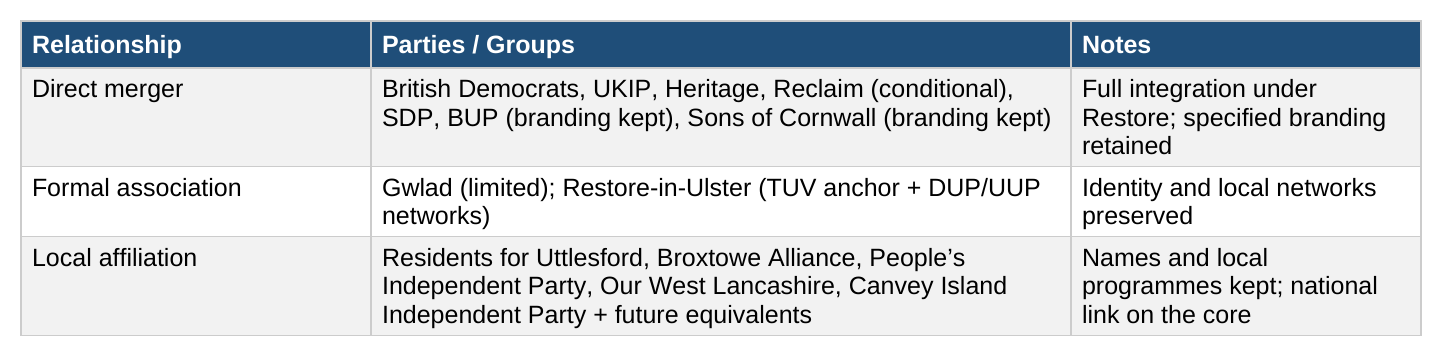
That’s the structure. Restore is the national home and the election vehicle. Mergers pull in the parties that are already close. Associations and affiliates extend the reach without pretending everyone agrees on everything. The alternative is another ten years of the same people beating each other while the things they actually care about keep getting worse.
Find me on X @BoonARTno10
Image: Diliff, CC BY-SA 2.5, via Wikimedia Commons